
AI in UK Television: A Workforce Running Ahead of Its Leaders?
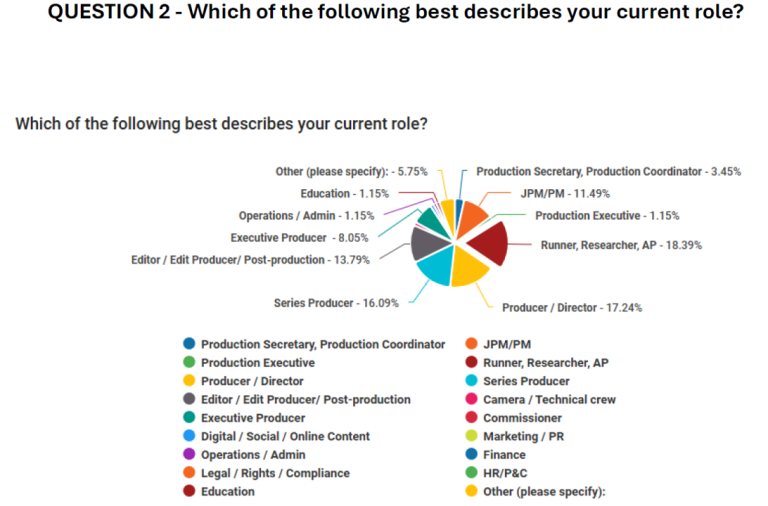
So, this summer, while studying for a diploma in AI, I ran a survey of over 100 people working across the UK TV production sector. Researchers, APs, PDs, PMs, SPs, editors, execs, freelancers etc (if you took part, thanks a mill!) The aim was simple. Cut through the noise and find out what is actually happening on the ground. Who is using AI? How much? Who is being trained? And what do people honestly think about the industry’s response so far?
If you work in UK television right now, you don’t need another report to tell you the industry is under pressure. Budgets have shrunk, schedules are tighter, and teams are smaller. Everyone is being asked to deliver more, in less time, with fewer people. Against that backdrop, the rise of AI has landed. Some are excited. Some are fearful. And now there’s talk of the bubble bursting. We are awash with noise.
But when I tried to find out who is actually using AI in telly, I really struggled to get info!
The findings paint a clear, and at times uncomfortable, picture. Most TV workers are already using AI tools. Almost none have been trained. And the overwhelming feeling is that the UK industry is not moving fast enough. This echoes other reports that came out this year on our industry that found there is a lack of artificial intelligence literacy and 'critical shortfall' in training in the UK TV industry (BFI/CoSTAR), causing an AI skills gap in the creative industries (Dept. of Education). The BFI warns there is a 'critical But could it mean our industry is missing out on solutions other struggling sectors have been able to tap into?
Here are the four headline messages my survey sends loud and clear.
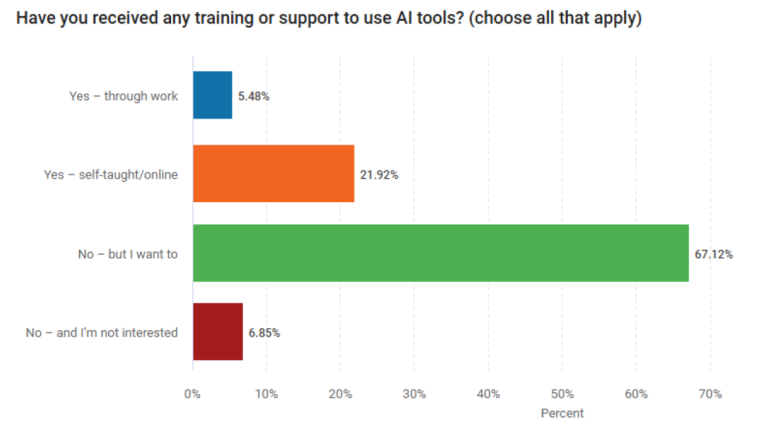
1. Most TV workers already use AI tools, but only around 6 percent have been trained
This was the first shock. Seventy percent of people said they are already using AI in their job.
But here is the issue. Only about six percent of respondents said they had received any workplace training. And over three quarters say they lack a good understanding of AI concepts. Most people are learning on their own, testing tools in their spare time and swapping tips with colleagues in WhatsApp groups. Many said they were actively discouraged from using AI by senior staff or broadcasters, often with reasons that were vague or contradictory.
One response simply said: “No reason, just that it is bad”.
Another: “We were told to be cautious, but no one could explain what that meant”.
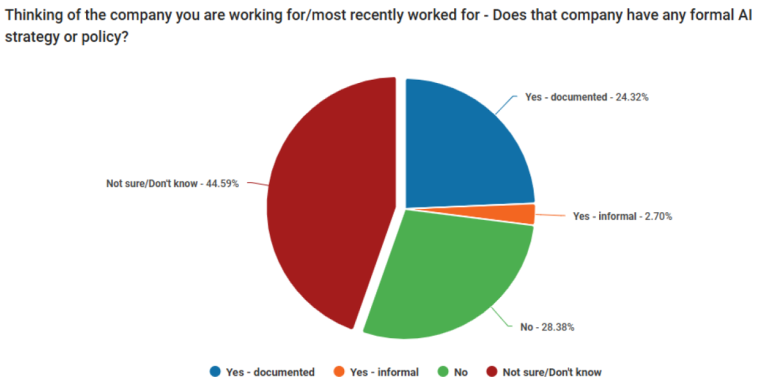
Of those surveyed, only 27% said the company they last worked for had an AI policy. This combination of high usage and low training feels like a red flag. It leaves workers exposed and unsure about what is allowed. It also creates inconsistent results, because everyone is interpreting their own unwritten rules.
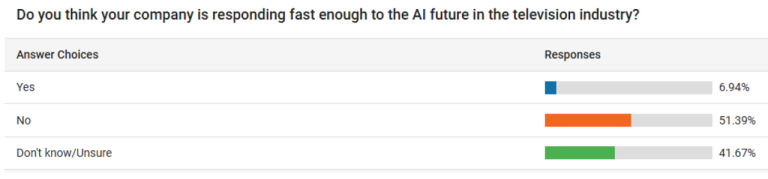
2. Most workers think the UK TV industry is not responding fast enough
Only seven percent of people believe companies are responding fast enough to the AI future. And the words people used to describe the industry’s approach were blunt.
“Slow and nervous.”
“Head in the sand.”
“A slow-motion car crash waiting to happen.”
“Paralysed with fear.”
“Very limited.”
The root of this hesitation is not hard to see. And there are very valid concerns around one branch of AI. Generative AI has triggered major concerns about copyright, ethics and ownership. And there are plenty of legal cases going on at the moment between producers and AI companies (I’ll write about this in future articles). This year some broadcasters have released new guidelines, and the BBC in particular has taken a very firm stance. These concerns are real. They matter. And no one wants to create new problems or risk viewer trust.
But the effect is that the entire conversation about AI has become tangled up with the most controversial part of it. Our industry is so focused on the copyright debate that we are missing everything else AI computing can do.
This was raised by survey respondents. Several said that while their managers were stuck discussing long term existential risks, the teams on the ground just needed support with everyday pressure. People talked about missed opportunities.
But could the fear around generative AI be shutting down the wrong conversation? The tools that could help strained teams right now are not being explored because they sit in the shadow of another debate. The result is an industry at risk of being too cautious at the top and too chaotic at the bottom.
3. We now have a situation where the workforce risks overtaking its leaders
This is the biggest tension revealed in the survey. The workforce is moving forward at speed. The leadership is moving slowly. In many sectors that gap leads to innovation. In television it’s creating risks.
What was clear from the survey was that workers are not using AI because it is trendy. They are using it because their workloads are heavy, deadlines are relentless, and staffing levels are lower than they used to be. It would seem, based on what people have said, that AI is not replacing creativity, its helping overstretched workers. And to be fair, this is unique to TV. A PwC survey found 41% of UK workers are facing a significant increase in their workload, while a KPMG report this year found 65% of workers now intentionally use AI at work to help.
But when workers adopt tools on their own without oversight or training, it can risk several problems:
• Ethical standards become inconsistent
• Research might be checked incorrectly
• GDPR rules could be broken accidentally
• Tools may be used in ways that breach broadcaster guidelines
• Mistakes go unnoticed because no process is in place to catch them
Is the UK TV sector inadvertently creating an environment where people feel pressure to use AI to keep up, but at the same time feel nervous that doing so might get them in trouble?
One respondent captured it perfectly:
“Everyone is using it to avoid being left behind, but no one is talking about it.”
You’ve got to wonder if this is sustainable. It also tells us something important. AI is no longer a future issue. It is already part of the job. The question is whether companies take control of it or leave their teams to figure it out alone.
Can AI tools actually offer usable solutions for the TV industry?
It’s a conversation worth having. Let’s look at other sectors in the UK. The answers there are promising, there is growing evidence that AI can deliver real savings and measurable returns for UK SMEs, not in theory, but in practice. SMEs, Small to Medium Entreprises, make up about 80% of the UK TV production sector, according to Ofcom.
A major study from the University of St Andrews this year, based on almost 10,000 UK small and medium-sized businesses, found that firms using AI achieved productivity gains of between 27 and 133 per cent compared with non-adopters.
Brightmine, part of LexisNexis, reports anonymised SME cases where AI has cut unplanned downtime by 30 per cent for a Birmingham manufacturer, saving around £100,000 a year, and reduced admin or customer-service costs by £40,000–£50,000 annually in several UK firms.
And an independent evaluation of 90 AI and data projects supported by the UK’s National Innovation Centre for Data in the North East, about half of them with SMEs, found 184 new jobs were created, with a further £742 million and 1,370 jobs expected from inward investment linked to that capability.
Okay, these are not TV production companies, and they are, of course, the success stories – but they show that UK SMEs who engage seriously with AI can find gains in cost, time and growth, sometimes alongside more jobs and investment, not less. And let’s be honest, in the new reality of smaller budgets and less time, the TV sector needs to at least be exploring these options in a calm, clear-headed way. No one is promising the holy grail, but the case for a new conversation about AI in TV is compelling.
How can we talk about AI in TV?
My survey, and other studies into our industry this year, make one thing very clear. The UK television production sector needs a better conversation about AI. Not a louder one. Not a more heated one. Just a better one.
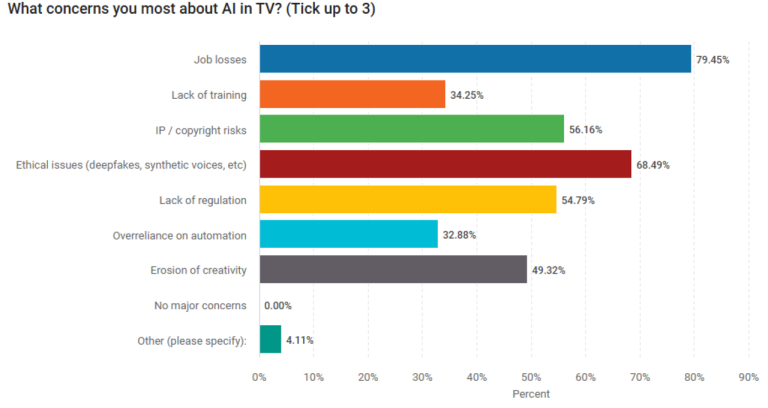
One that separates the valid copyright debates from operational improvements. One that helps people, not replaces them. One that acknowledges what is already happening in real production offices rather than what people imagine is happening. Any new conversation of course needs to address workers’ fears of job losses by AI. My survey found job losses was the main concern about AI (79%), even though less than 10% of people have actually witnessed job losses caused by AI.
AI is not going away. It is not a passing trend. Yes, the over concentrated investment bubble in AI might be about to burst, but the ‘dot-com crash’ in the nineties wasn’t the end of the internet, it created the technological backbone for the internet we know today – that gave rise to social media and the streamers we now have to compete with! AI is the next phase of how we work with computers. And in a sector under as much strain like ours, other sectors in the UK are showing us that there are tools available right now that can ease workloads, that at least merit looking at.
But that will only happen if the conversation moves from fear to leadership.
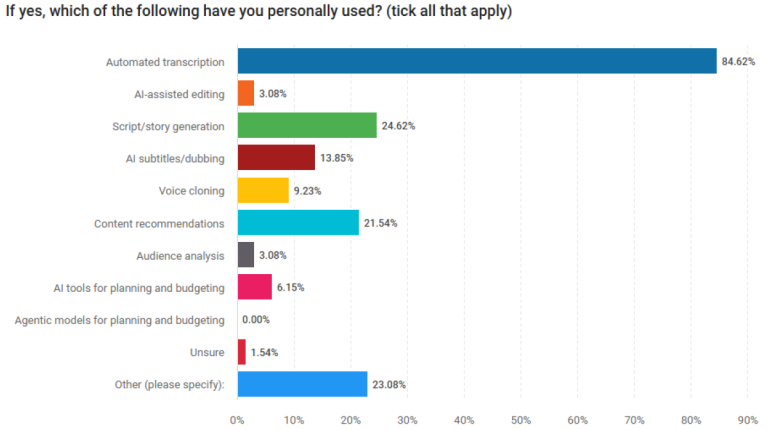
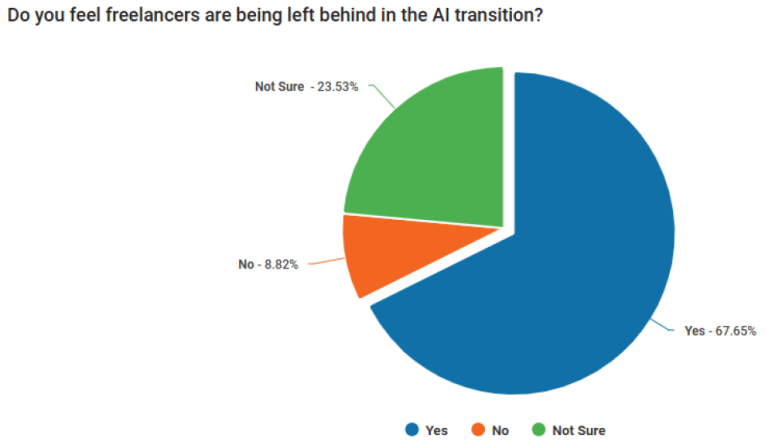
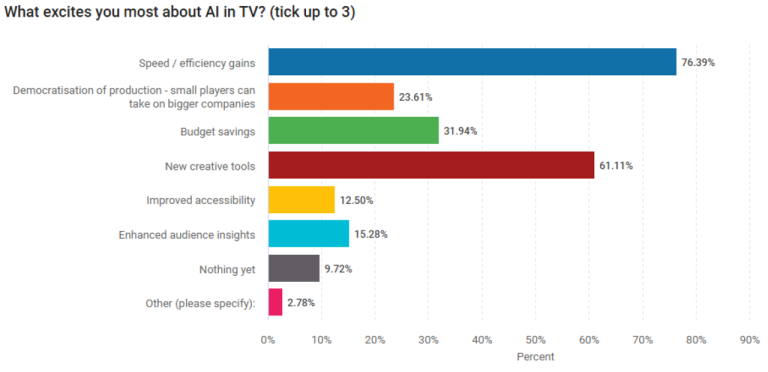
Other results from survey:
The anonymous survey was carried out online using ‘Smart Survey’, through open invitation using various social media groups for UK TV workers, as part of my ‘Professional Diploma in Artificial Intelligence’, through University College Dublin’s Professional Academy, in which I obtained a Distinction. There were 102 respondents.
References:
https://a.storyblok.com/f/313404/x/ac4c0235f7/ai-in-the-screen-sector.pdf
https://kpmg.com/uk/en/insights/ai/uk-attitudes-to-ai.html